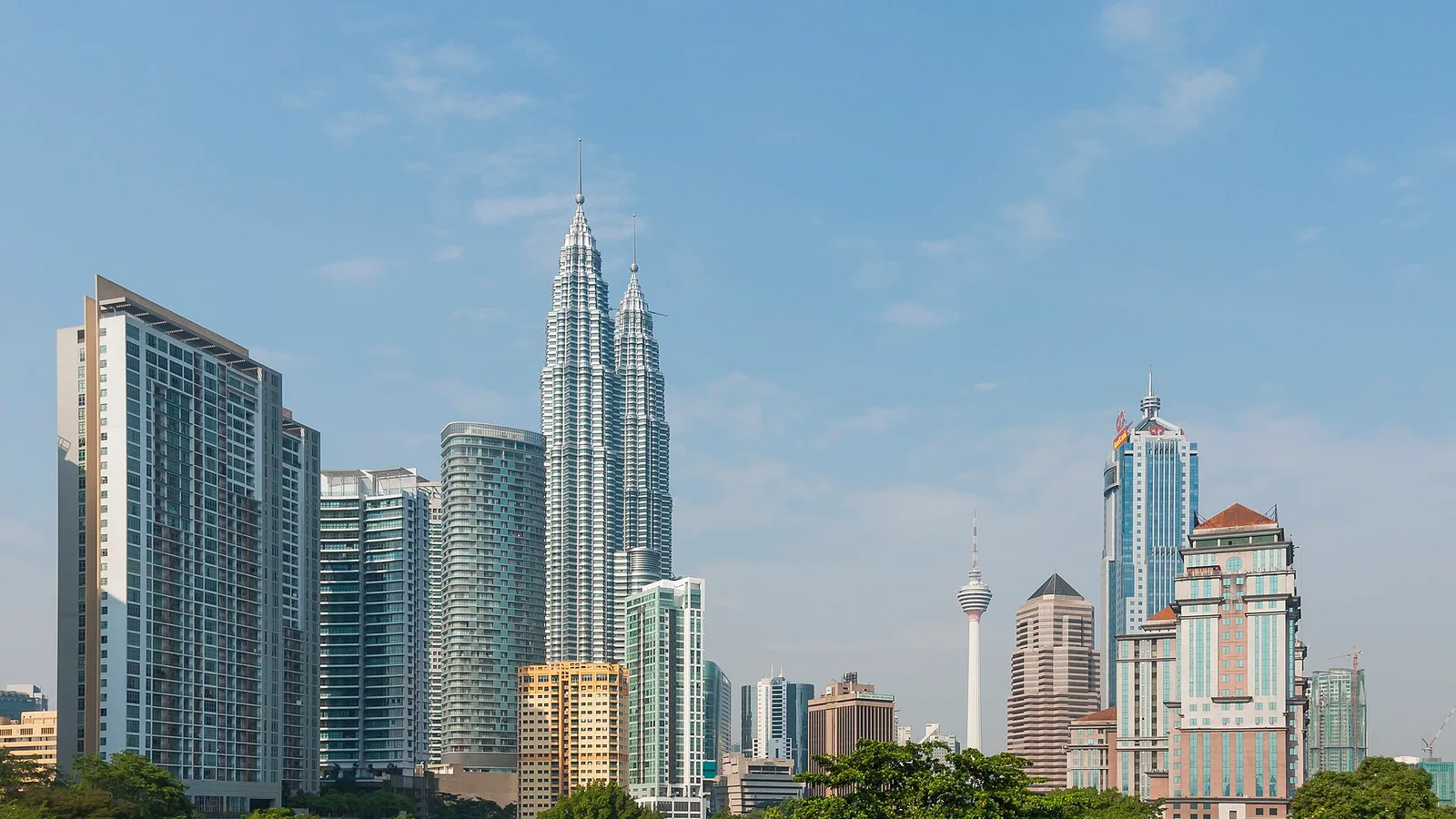
Take the KLIA Ekspres from the airport rather than a taxi, base yourself near a rail station, and plan on three nights: one to land and sleep off the flight, one full day for the towers and the centre, and one for Batu Caves and the food. The city is easier to cross by train than by road, which is why the station matters more than the hotel.
This is a city of districts that don’t touch each other the way a map suggests. KLCC, Bukit Bintang and Chinatown each have their own character, their own station and their own traffic, so your base decides how much of your trip you spend in transit.
From KLIA to the centre by train
The KLIA Ekspres links both airport terminals with KL Sentral, the main rail hub. Express Rail Link, the operator, says the ride between KL Sentral and KLIA Terminal 1 takes 28 minutes, with three more minutes between Terminal 1 and Terminal 2. Trains run every 20 minutes, all day, every day, including weekends and national public holidays. Before you fly, read up on the entry rules and the MDAC arrival card, including when to file it.
| Adult | Child (6-15) | Notes | |
|---|---|---|---|
| One-way, until 31 December 2026 | RM55 | RM25 | Children under 6 travel free, up to three per adult; collect the free one-way ticket at the counter each trip, with proof of age |
| Return, until 31 December 2026 | RM100 | RM45 | Same age bands |
| One-way, from 1 January 2027 | RM65 | RM29 | Fare adjustment announced by the operator |
| Return, from 1 January 2027 | RM118 | RM53 |
Prices are the operator’s, read on 16 November 2026, for the standard ticket, and buying online on the operator’s website or app takes 10% off. The operator also says tickets can be bought up to six months in advance at the prevailing fare, so if you fly in early 2027, buy before 1 January and you’ll travel at the 2026 price.
For timing, the schedule the operator publishes, effective 8 December 2025, lists departures from KL Sentral between 05:00 and 00:00, and from KLIA Terminal 2 between 04:55 and 01:00. From 23:00 every train stops at all stations, so the 23:00 departure from KL Sentral reaches Terminal 1 in 37 minutes rather than 28, and the last two trains from Terminal 2 leave at 00:30 and 01:00. Check the current PDF on the operator’s site before relying on a midnight arrival, because timetables get revised.
The train wins on predictability: its journey time doesn’t depend on road traffic. A taxi or a Grab makes sense only if your flight lands when the trains aren’t running, or you have a lot of luggage and your hotel is far from a station. From KL Sentral you change onto the LRT or MRT, or take a short ride-hailing hop.
Where to base yourself
| Base | Suits | Trade-off |
|---|---|---|
| KLCC | First visit, the towers, the park, a high-end mall | Hotels cost more; fewer cheap places to eat |
| Bukit Bintang | Shopping, nightlife, Jalan Alor’s street food, many hotel price levels | Busy and loud at night |
| Chinatown (Petaling Street area) | Cheap rooms, street food, MRT at Pasar Seni | Crowded market streets, older rooms |
| Near KL Sentral | Early trains, the airport train, onward travel | Fewer evening options on foot |
A first-time visitor will do well in KLCC or Bukit Bintang, the second one if the budget matters. Choose Chinatown if you want to be among the food stalls and don’t mind the noise, and KL Sentral if you’ve an early train north to Penang or a flight to catch.
Getting around the city
KL runs an integrated rail network: KTM, LRT, MRT and the monorail meet at interchanges including KL Sentral, Masjid Jamek, Pasar Seni and Bukit Nanas. That’s one of the better reasons to base yourself near a station, and the Petronas Twin Towers page has the line-by-line route to KLCC.
There’s also the GOKL city bus, a free service: its Green Line runs from Bukit Bintang to KLCC, which is handy for a hop between the two districts. For late nights or luggage, Grab works in the city, and if you take an ordinary taxi, ask the driver to switch the meter on before you set off.
Your first evening
If you land in the afternoon or evening, you reach KL Sentral with nothing planned, which suits a short first outing rather than a sightseeing marathon. Drop your bags, take the LRT to KLCC and walk into KLCC Park, open 10.00am to 10.00pm daily on Suria KLCC’s page; the lake shows start in the evening, with the times on the Petronas Twin Towers page. Have dinner at the mall or near your hotel and turn in at a sensible hour, and the full day ahead goes better for it.
Two full days
Day 2: the towers and the centre. The Petronas Twin Towers are the obvious anchor: tickets, the Skybridge and Level 86, and the Monday closures all have their own page, so plan the date first. Spend the hot middle of the day indoors at Suria KLCC, take an early-evening slot up the towers, then ride the rail to Bukit Bintang for dinner on Jalan Alor.
Day 3: Batu Caves and Chinatown. Go to Batu Caves first thing (the train and the hours are in the Batu Caves section below), be back by lunch, and give the afternoon to Chinatown and the streets around Pasar Seni. Central Market, which began as a wet market in 1888, runs two floors of crafts and, on Tourism Malaysia’s page, opens daily 10.00am to 9.30pm; Petaling Street, a few minutes’ walk away, has its market stalls open daily 8.00am to 10.00pm. Then walk or ride on to Merdeka Square, where the Union Jack came down and the Malayan flag went up at midnight on 31 August 1957. The Sultan Abdul Samad Building on its east side has reopened to visitors after conservation, with gallery exhibitions inside, so check its visiting hours on the day. Masjid Jamek, at the meeting of the two rivers, welcomes non-Muslim visitors outside prayer times if you dress modestly; its hours are shorter on Fridays. Don’t try to walk between districts in the middle of the day: take the rail.
A fourth day is where Kuala Lumpur starts to repeat itself, unless you spend it on a trip out of the city.
Where to eat
Tourism Malaysia’s guide to the city, with details marked as correct in June 2026, points the evenings at Jalan Alor in Bukit Bintang: stalls open from about 5.00pm until late, most are closed on Mondays, and many are Chinese-operated, so halal status varies by stall; look for the JAKIM certificate on the cart or ask before ordering. For lunch in Chinatown, the same guide sends you to the old stalls on Petaling Street for Hokkien mee, assam laksa, wan tan mee and curry noodles. For breakfast, it names Kampung Baru, the Malay enclave close to the city centre, where nasi lemak is on sale from first light. We’d keep the Jalan Alor evening for any day but Monday. Our guide to what to eat in Malaysia helps decode nasi lemak, roti canai and the noodle dishes you’ll see on menus.
Batu Caves and other day trips
Batu Caves is a limestone hill north of the centre with a Hindu temple cave at the top of 272 steps. Visit Selangor lists entry to the temple cave as free, and the temple cave hours as 6.00am to 9.00pm; Ramayana Cave, Cave Villa and the other attractions on the site have their own hours and charges, and the page’s figures for them are undated, so confirm on the day. KTM Komuter trains run from KL Sentral to Batu Caves, the last station on the line. Go early: the climb is a steep flight of steps and you’ll be doing it in the open.
If you’re linking Kuala Lumpur to the rest of the peninsula, the 10-day Peninsular Malaysia route starts here and heads first for the Cameron Highlands, by bus from TBS (Terminal Bersepadu Selatan).
Leaving: check in at KL Sentral
On the way out, the same operator runs an in-town check-in at KL Sentral for Malaysia Airlines and Batik Air passengers, which lets you drop your bags before the train. You need a valid KLIA Ekspres or KLIA Transit ticket for the airport sector to enter the check-in area. Counters are listed as open 6.00am to 8.00pm daily for Malaysia Airlines and 6.00am to 6.00pm daily for Batik Air, with a cut-off of two hours before departure, and your bags go through to your flight at Terminal 1. If you fly another airline, or from Terminal 2, plan the usual airport check-in time instead.
Heading north
From KL Sentral the ETS intercity train runs north to Butterworth, the mainland stop for Penang; the Penang guide covers the train, the ferry across and the island itself. If you’re collecting a vehicle after your city stay, check our guide to car hire in Malaysia.
How many days
- One night: the airport train, an evening at KLCC, an early start.
- Two nights: add the towers and a district walk.
- Three nights: add Batu Caves and an unhurried food evening.
- More: only if you’re using Kuala Lumpur as a base for trips.
If wildlife is the reason for the trip, choosing a rainforest trip starts with deciding between Taman Negara on the peninsula and Sepilok or the Kinabatangan in Borneo.
Photos
On the map
The map loads on click, to keep the page light.
The map didn’t load. Check your connection and refresh the page.
Read also

What to see · 7 min read
Batu Caves: 272 Steps, Free Temple Entry and the Train
Updated · 17 November 2026Batu Caves from Kuala Lumpur: free entry to the temple cave, 6am-9pm hours, 272 steps, the KTM Komuter train (about 30 minutes) and Thaipusam 2027.

Car hire · 7 min read
Car Hire in Malaysia: Licence, Tolls and Driving on the Left
Updated · 17 November 2026Car hire in Malaysia: home licence plus an IDP for UK, US and Australian drivers, Hertz deposit and excess, cashless tolls and driving on the left.

Things to do · 9 min read
Diving and Snorkelling in Malaysia: Reefs, Seasons, Sipadan
Updated · 17 November 2026Redang and Tioman run roughly March to October, Perhentian resort by resort; Sipadan needs a permit and an FCDO warning read first. Fees in RM.

What to see · 7 min read
Langkawi SkyCab and SkyBridge: Prices, Hours and Access
Updated · 17 November 2026Langkawi SkyCab from RM33, open 9.30am-6.00pm, 708 m Top Station, SkyBridge steps or SkyGlide, and how weather closures and ticket dates work.